Frame2Text4LLM
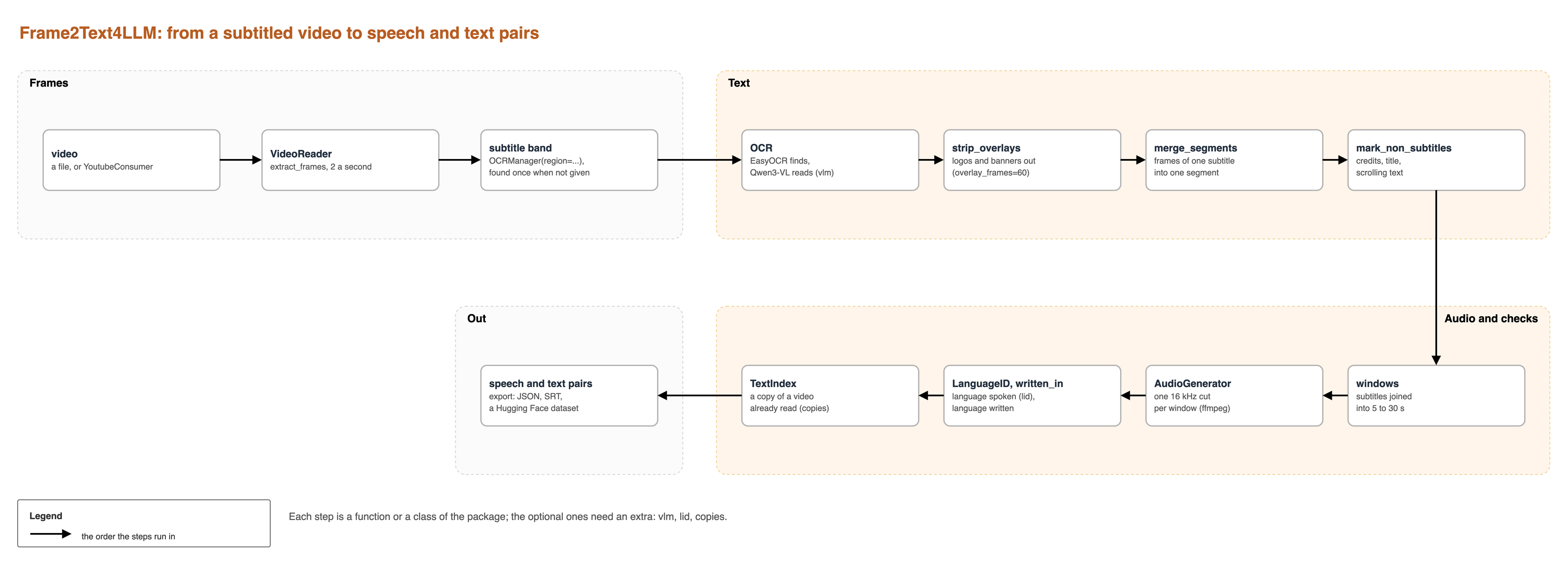
Many videos carry their translation burned into the picture: a series in Mooré with French subtitles, a sermon in Dioula subtitled in English. Frame2Text4LLM reads those subtitles with OCR, finds when each one starts and ends, and cuts the audio underneath. What comes out is a set of pairs, the speech and the text that goes with it, ready for a speech recognition or speech translation dataset.
Install
pip install "frame2text4llm[easyocr]"
The OCR engines are extras, so that you install only the one you use:
| extra | engine | needs |
|---|---|---|
easyocr |
EasyOCR | torch |
paddle |
PaddleOCR 3.x | paddlepaddle |
vlm |
vision-language models (Qwen3-VL, Florence-2, InternVL2) | torch, transformers |
openai |
OpenAI vision models | an API key |
all |
all of the above |
Mistral OCR needs only an API key. Audio cuts need ffmpeg on the path.
Where to go next
- Getting started: one video, from frames to audio cuts.
- How it works: each step and its parameters.
- Choosing an OCR engine: what each engine gets right, measured.
- A YouTube video to a speech dataset: the two-pass recipe.
Frame2Text4LLM was written by Alban Nyantudre and Salif Sawadogo for BurkimbIA, which builds speech and language tools for the languages of Burkina Faso. MIT licence.