How it works
Each step is one class, and each can be used alone.
| step | class | what it does |
|---|---|---|
| download | consumer.youtube_consumer.YoutubeConsumer |
a video or a playlist from YouTube, with pytubefix |
| frames | framer.VideoReader |
frames at a chosen rate, each with its time |
| band | framer.SubtitleRegionDetector |
where the subtitles are, if you do not say |
| OCR | ocr.OCRManager, ocr.OCRBatchProcessor |
one engine on one frame, or on all of them |
| overlays | process_batch(overlay_frames=60), strip_overlays |
logos and banners out of the frames |
| subtitles | process_batch(merge_segments=True) |
frames that show one subtitle become one segment |
| not subtitles | ocr.utils.mark_non_subtitles |
credits, the title, scrolling text marked |
| windows | ocr.utils.windows |
subtitles joined into windows of 5 to 30 s |
| audio | export.audio_generator.AudioGenerator |
one WAV per segment or window, with ffmpeg |
| export | export.SRTExporter, export.JSONExporter, export.HuggingfaceCooker |
files, or a Hugging Face dataset |
| language | language.LanguageID, language.written_in |
language spoken in a window, and written |
| copies | copies.TextIndex |
the video a subtitle line was already read in |
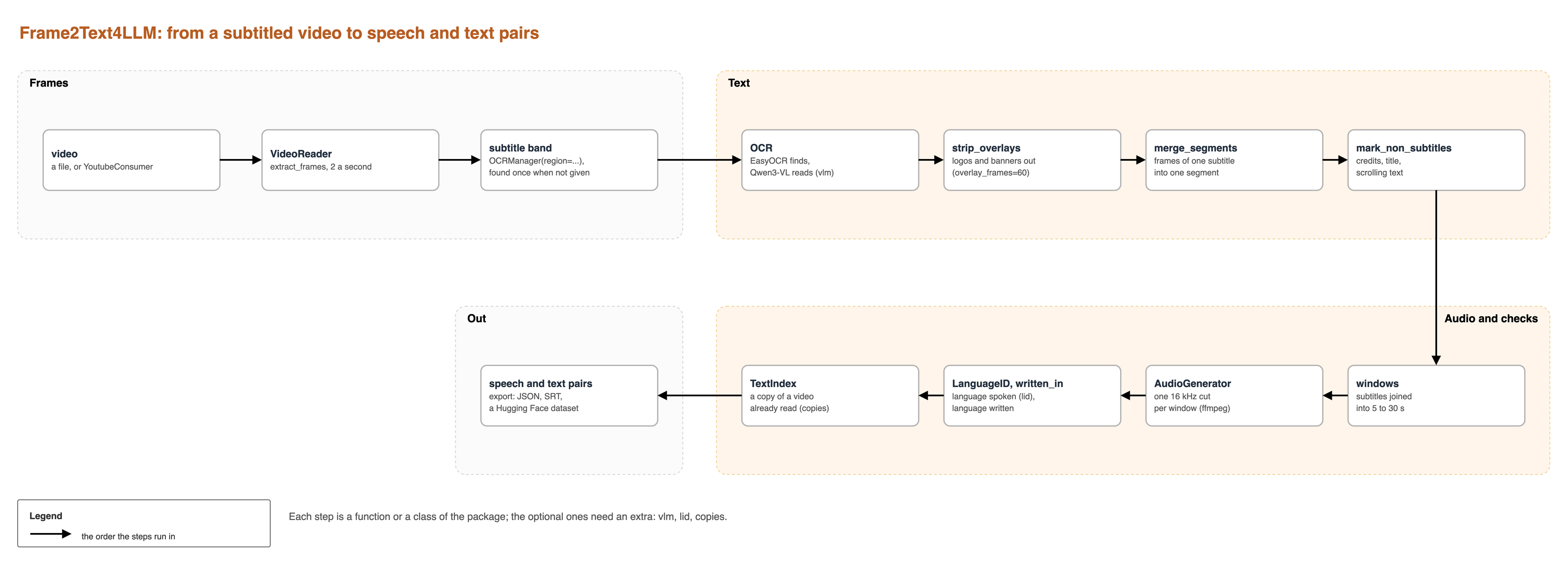
The diagram's source is docs/diagrams/pipeline.drawio: open it in draw.io, change it, and export the PNG and
SVG next to it.
Frames
VideoReader.extract_frames(target_fps=2) keeps one frame in round(video_fps / 2): at 25 frames
per second, one every 0.48 s. Each VideoFrame has image (BGR, as OpenCV reads it), time in
seconds and time_formatted (MM:SS:mmm).
filter_duplicates=True drops a frame whose picture hash is close to the previous kept frame's.
It saves OCR time on static shots, but the hash looks at the whole picture, and a subtitle that
changes on a still shot is a small change: the new subtitle is dropped with the frame. Leave it off
when you cut audio.
Merging frames into subtitles
An OCR engine does not read the same line the same way twice: one frame loses a word, the next an accent, the third reads only one of two lines. If every new reading opened a segment, a subtitle that stays five seconds on screen would come out as five one-second pieces, each with its audio cut short.
merge_segments=True treats two readings as one subtitle when either
- they look alike:
difflibsimilarity of at leastsim_thresh(0.8), or - at least half the words of the shorter one, three letters or more, accents ignored, are in the
other (
min_shared, 0.5),
and one frame read as empty inside a subtitle does not end it (max_gap, 1). A segment ends on the
first frame that shows something else, or nothing. It keeps the longest reading as text, and the
frame of that reading as best_time.
On one episode, this turned 224 one-second pieces into 126 subtitles of four seconds. Two short subtitles in a row that share half their words ("Oui papa", then "Non papa") become one: the price of the rule.
Text that is not a subtitle
A logo, a channel's banner, credits and scrolling text are read too. Two functions take them out, with the rules gom-dɛɛsa measured on Burkinabè videos subtitled in French.
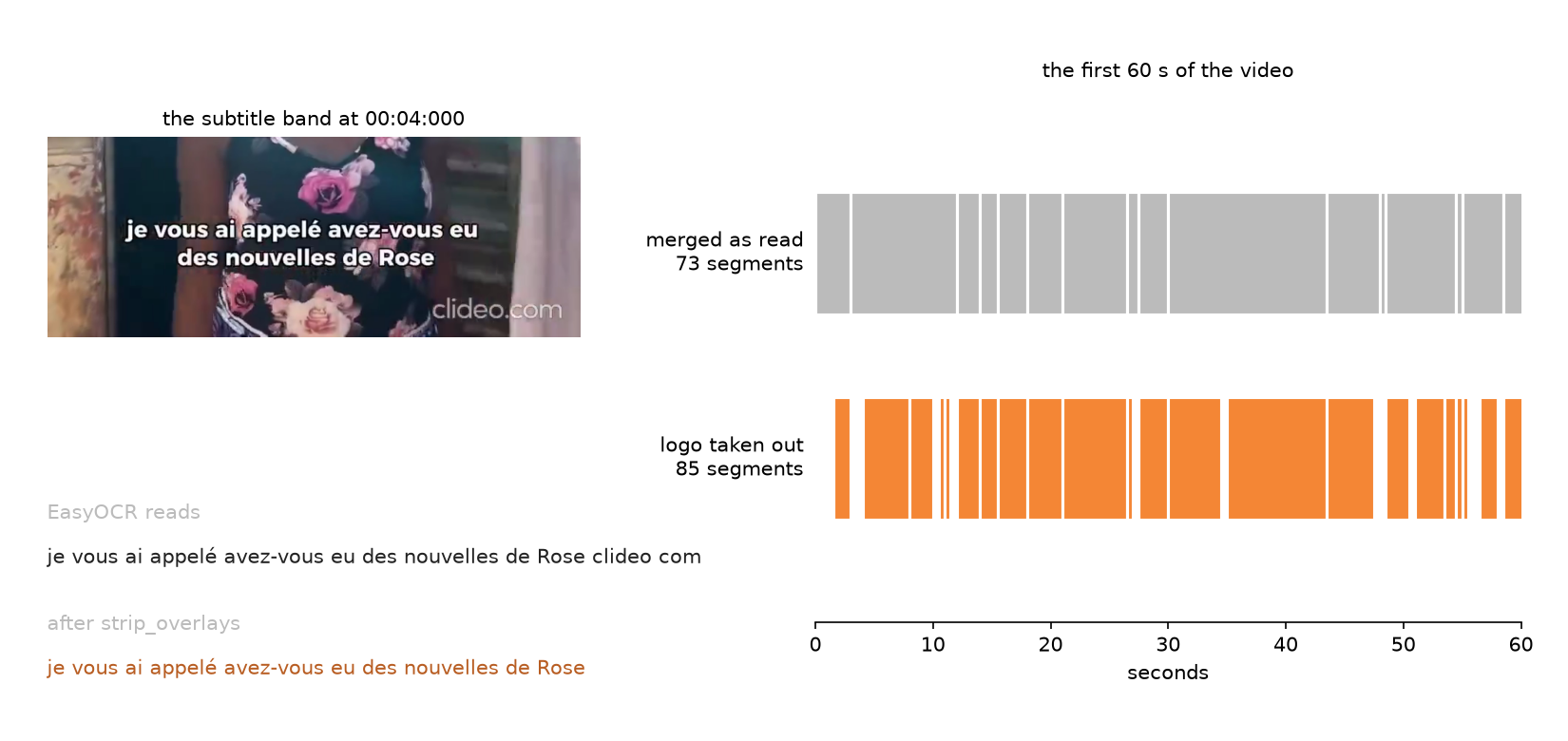
overlay_frames=60 in process_batch (or strip_overlays(results) on the frames) takes out of
each frame the words read on 60 frames in a row or more, up to two frames missed: 30 s at 2 frames
a second. No subtitle stays that long. Words are compared without case or punctuation, and two
neighbours also count joined: the OCR reads one logo as clideo com, clideocom and clideo.com. Left in, a logo next to every subtitle would make
merge_segments join them all into one segment.
mark_non_subtitles(segments, duration, title) gives each merged segment a drop, "" for a
subtitle:
"credits": a credits word (réalisation, montage, production, ©...), two words in capitals, a first name and a NAME as a cast list prints them, or the video's title. A credit after 85 % of the video drops everything after it."ticker": three segments or more in a row, each the one before moved.
A video subtitled all in capitals loses every line to the capitals rule.
Windows
A subtitle alone lasts two or three seconds, often too short to train speech recognition on.
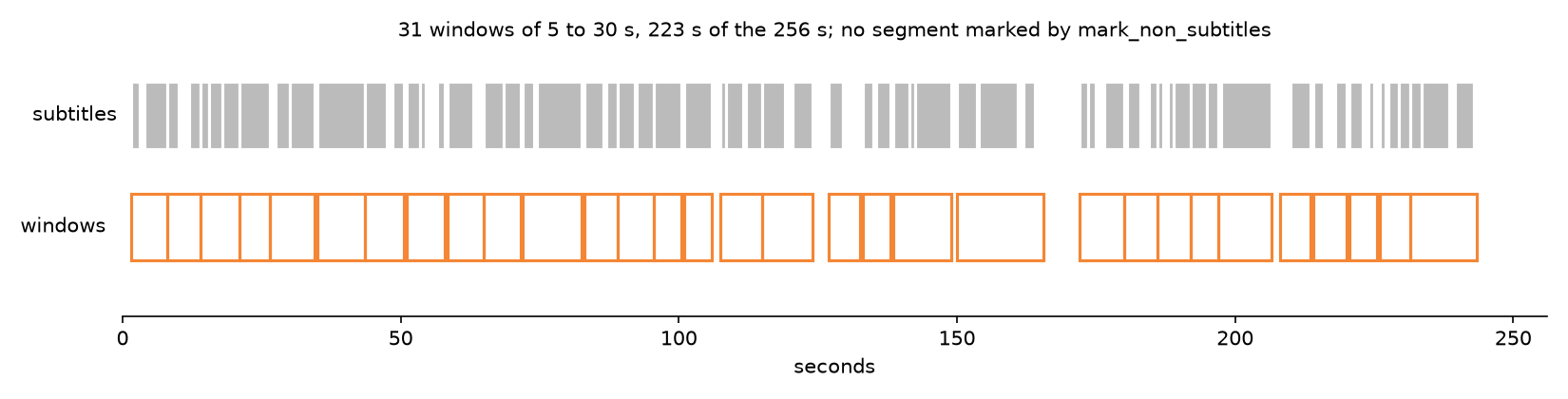
windows(segments) joins consecutive subtitles less than 2 s apart (gap) into windows of at least
5 s (low); a short tail joins the window before it. A segment marked by mark_non_subtitles ends
a window, since its sound has no text. Windows under 5 s or over 30 s (high) are left out.
Each window is a segment: the subtitles' text end to end, the first one's start, the last one's
end, and the subtitles in subtitles. AudioGenerator.extract_segments(windows(segments)) cuts one
file per window.
Language
A video subtitled in French may be spoken in French, or mix a French narrator with speakers of another language: only the windows spoken in that language pair with their subtitles.
LanguageID().hear(paths) runs MMS-LID (facebook/mms-lid-256, 256 languages) on 16 kHz mono
files and gives, for each, the language heard most and the probability of the languages in
languages (Moore, Dioula, Bambara and French by default). It needs the lid extra.
written_in(text) says whether a subtitle is written in French or English by counting function
words (le, que, pas; the, what, not), and "other" when they tie.
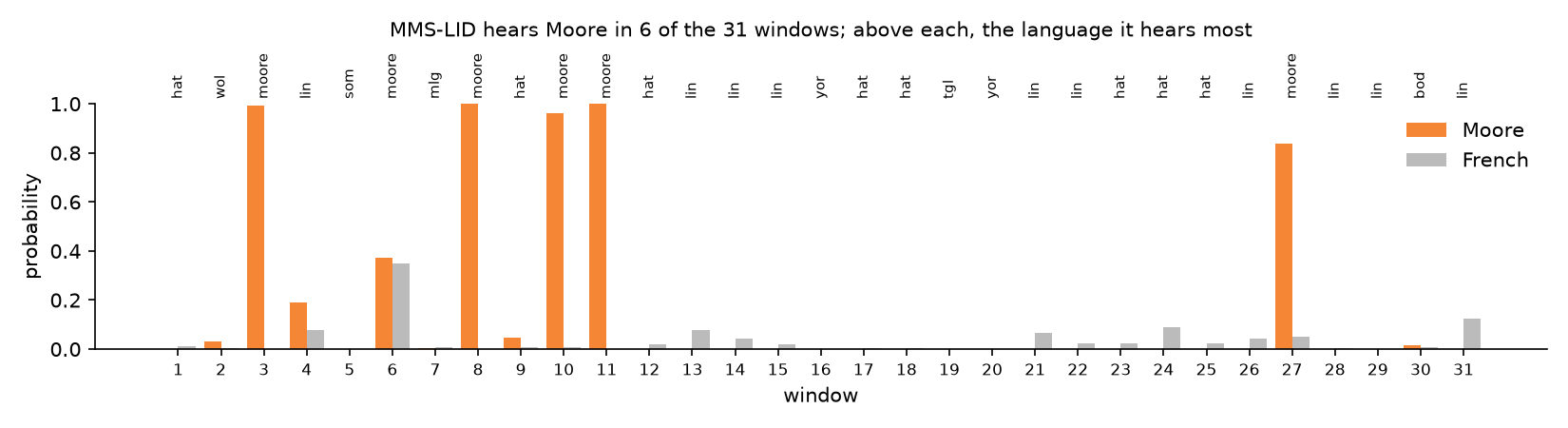
On this sketch MMS-LID hears Moore in 6 windows of 31, and spreads the others over Lingala, Haitian Creole, Yoruba and five more: its answer alone does not tell a window's language here.
The three figures come from sandbox/sample_short.mp4, made by scripts/figures.py.
Copies
The same film is often published by several channels, cut or re-encoded: its duration does not tell
a copy, its subtitles do. TextIndex keeps the subtitles of the videos read so far (add(key,
texts)), and closest(line) gives the video one new line comes from, with a score out of 100. It
needs the copies extra.
A line read by OCR is noisy (Blane for Blanc), so character 5-grams pick the ten videos closest to it, then the best alignment of the line inside each video's whole text decides. In gom-dɛɛsa, 85 or more was a copy, and between 70 and 85 the video was worth a look.
Audio
AudioGenerator(video, tmp_audio_dir).extract_segments(segments) runs ffmpeg once per segment and
writes segment_0000.wav and on, 16 kHz mono, from start_time to end_time. Times are read as
MM:SS:mmm, HH:MM:SS or HH:MM:SS.mmm.